Sugar-free electrolyte water
Same numbers as the sachet. Roughly four cents instead of a euro fifty.
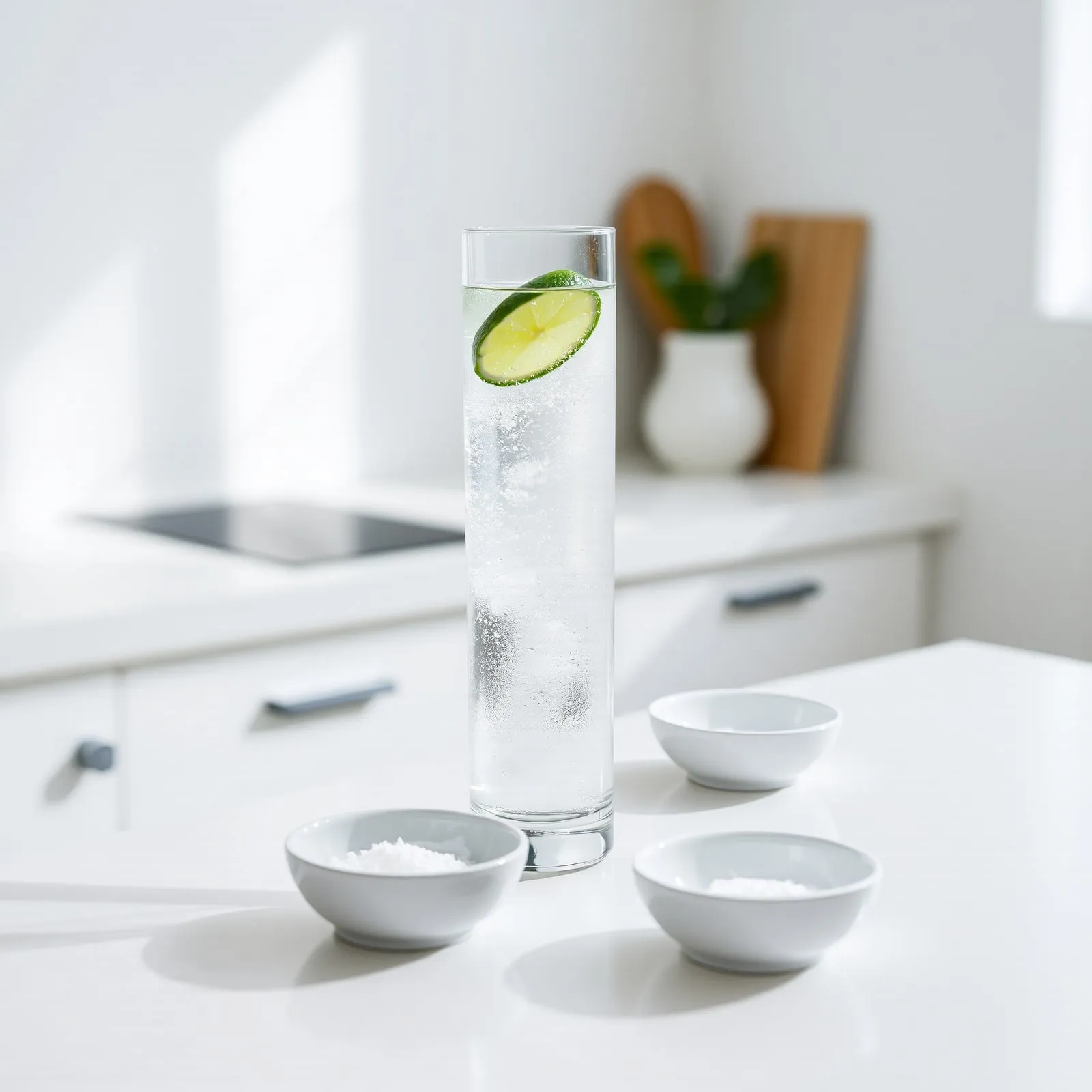
The expensive electrolyte sachets are, chemically, salt and potassium salt with flavouring. That is not a criticism — it is genuinely what your body loses in sweat, and the ratios in the good ones are sensible. It is just that the ingredients cost almost nothing.
This makes the same thing from two salts you can buy in any supermarket, with no sugar at all. It tastes like a sachet too, which is to say: mineral, faintly savoury, and better cold than warm.
The one thing you cannot easily replicate at home is magnesium, so if that is why you buy the sachets, keep buying them.
How to make it
- Hands on
- 2 min
- Total
- 2 min
- Makes
- 1 serving
- Per glass
- 4 kcal
Ingredients
Method
-
Measure both salts
Measure, do not eyeball. Potassium chloride in particular tastes strongly metallic if you overshoot, and there is no rescuing a glass you have overdone.
-
Dissolve in a splash
Add both salts to a little warm water first and stir until clear. They dissolve slowly in cold water and you will otherwise get a salty mouthful at the end.
-
Add citrus and top up
Stir in the lemon juice, then top with cold water. The citrus is doing real work here — without it the drink tastes flat and mineral.
Worth knowing
- "Lite salt", "low-sodium salt" and LoSalt are all the same thing: a potassium chloride blend. Check the label says potassium chloride.
- Make it in a bottle you can shake rather than a glass you have to stir.
- If it tastes metallic, you used too much lite salt. Halve it next time.
What it actually does for you
- Calories
- 4 kcal
- Sugar
- 0.4 g
- Sodium
- 590 mg
- Potassium
- 390 mg
The most complete electrolyte drink here that contains no sugar, and it is in the same territory as a commercial sachet on both sodium and potassium. The honest gap is magnesium: there is essentially none, and adding it at home means buying magnesium powder, at which point the sachet starts looking reasonable again.
How this was worked out: Table salt is 39.3% sodium by mass, so 1.5 g gives 590 mg sodium. Potassium chloride is 52.4% potassium, so 0.75 g gives 393 mg. Lemon juice contributes about 4 kcal and 15 mg potassium (USDA FoodData Central). For comparison, a typical electrolyte sachet lists 1000 mg sodium and 200 mg potassium.
Variations
- Add a teaspoon of honey if you are drinking it during exercise rather than after — a little sugar speeds absorption.
- Use sparkling water for something much closer to a shop-bought drink.

Making it is the easy part
Remembering to drink it is the hard part. Honk watches your webcam with on-device AI and honks until you do, as gently or as loudly as you like.
Meet Honk → join the waitlistQuestions
Is this the same as an LMNT or electrolyte sachet?
On sodium and potassium it is in the same range — this recipe gives about 590 mg sodium and 390 mg potassium against a typical sachet's 1000 mg and 200 mg. What you do not get is magnesium, or the flavouring that makes the commercial version pleasant rather than merely tolerable. If you want the exact sachet profile, double the sea salt.
Is potassium chloride safe to use?
For most healthy people, in these quantities, yes — it is sold as ordinary table salt substitute. It is a genuine exception if you have kidney disease, or take potassium-sparing diuretics, ACE inhibitors or angiotensin receptor blockers, because those all raise blood potassium. If any of that applies, leave the lite salt out and speak to your doctor.
Do you need electrolytes if you are not exercising?
Usually not. A normal diet supplies plenty of sodium and potassium, and a desk day in an air-conditioned office does not deplete them. This is a drink for after heavy sweating, illness or real heat — not a daily supplement.